Introduction
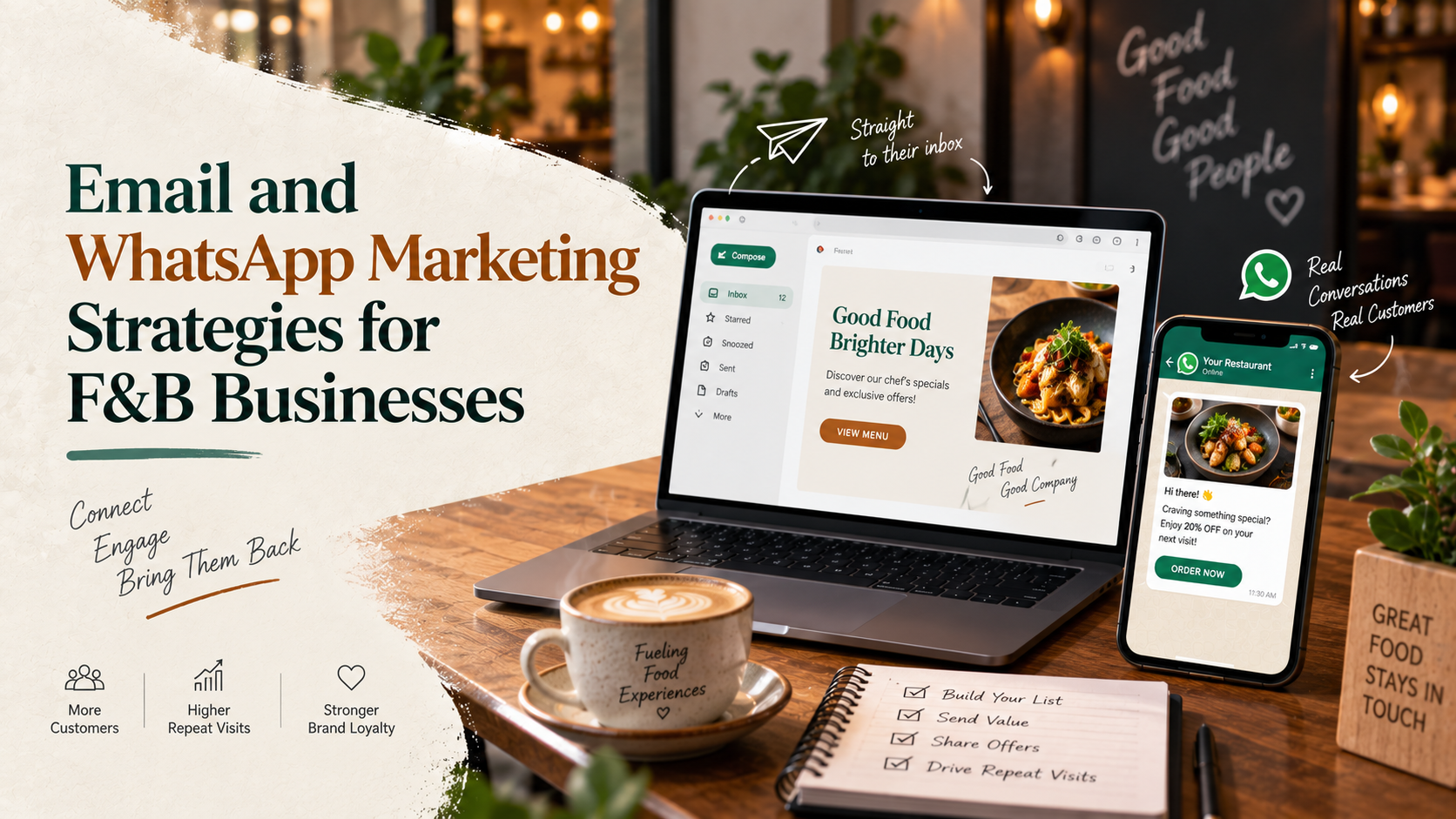
Acquiring a new customer costs significantly more than bringing back one who has already visited and enjoyed the experience. Email and WhatsApp marketing, often overlooked in favor of social media, are among the most direct and cost-effective ways F&B businesses can stay in touch with past customers and drive repeat visits.
Chennai institutions like Murugan Idli Shop and Fruit Shop on Greams Road — a name with more than 30 years in Chennai's F&B scene — were built on the same mechanic: someone who already liked what you served, coming back for more.
Build the List at the Point of a Great Experience
The best time to capture a customer's contact details is right after a positive experience — at checkout, through a simple loyalty sign-up, or via a QR code on the receipt, when they are most receptive. Asking for this information as a routine, low-friction part of the visit builds a list far faster than relying on occasional social media prompts alone.
Keep the Cadence Light and the Value High
Customers unsubscribe quickly from businesses that message too often with purely promotional content. A sustainable cadence — perhaps a monthly update plus occasional, genuinely relevant offers, mixing new menu announcements, events, and modest perks — keeps the channel valuable rather than annoying.
WhatsApp for Immediate, Personal Touches
WhatsApp's high open rates make it well suited for time-sensitive messages — a table reservation confirmation, a birthday offer, a same-day special — provided customers have genuinely opted in and messages stay infrequent and personal rather than broadcast-style spam. Overusing this channel risks damaging a relationship that email alone would not.
Segment by Behavior, Not Just Demographics
A regular weekday lunch customer and an occasional special-occasion diner want very different messages. Segmenting the list by actual visit behavior — frequency, spend, preferred day-part — and tailoring offers accordingly produces meaningfully better response rates than sending the same generic message to the entire list.
Turning Marketing Data Into Better Business Decisions
The most valuable outcome of good F&B marketing isn't the campaign itself — it's what the business learns from it. Tracking which dishes get the most engagement, which offers actually drive redemptions, and which channels bring in the highest-spending repeat customers gives an owner real information to guide menu decisions, pricing, and even which locations or day-parts deserve more operational focus.
Too many F&B businesses treat marketing and operations as separate departments that rarely talk to each other, when in reality marketing data — what customers respond to, when they visit, what they order after seeing a specific post — is some of the richest business intelligence a restaurant or cafe has access to. Building a simple habit of reviewing this data monthly alongside sales and kitchen performance turns marketing from a cost center into a genuine source of strategic insight for the wider business.
What This Looks Like in Practice
At[ Aaytham Consulting](https://aaythamconsulting.com/), this kind of work starts with brand positioning, not a content calendar — making sure campaigns and channels amplify a brand identity that's already distinct, and pairing that with the strategic and operational grounding to make sure recommendations fit what a kitchen and team can actually sustain.
Fruit Shop on Greams Road is a good example. [Co-founder Harris Abdulla has spoken about being hesitant to bring in outside consultants at first](https://www.linkedin.com/feed/update/urn\:li\:activity:7483177309500448769) — and about how, within six months of working with AyC, sharper business insights and hands-on management consulting helped the brand spot opportunities it had been missing. Read more about that engagement on[ AyC's journey page](https://aaythamconsulting.com/journey).
The same connected-system thinking shows up beyond F&B too. For one D2C retail brand working with a tight budget in a crowded category, AyC built a single funnel — storefront, creative, and paid media — running from awareness straight through to purchase, rather than treating ads as a standalone spend line: 5M+ reach, 500+ purchases, 500% revenue growth.[ See the breakdown on Instagram](https://www.instagram.com/reel/DbVRH76iP3a/).
For more real client outcomes, browse[ AyC's impact page](https://aaythamconsulting.com/impact) or the[ full blog archive](https://aaythamconsulting.com/blogs). One related read: [how operational efficiency (the Toyota Production System) cuts costs](https://www.linkedin.com/pulse/how-reduce-operational-costs-through-efficiency-toyota-ympwc/) — a useful companion piece if the marketing side of this article has you thinking about the operations side too.
Conclusion
Done well, email and WhatsApp marketing quietly outperform paid social on cost per repeat visit — a thoughtfully built list, a light cadence, and messages segmented around real customer behavior are what turn a one-time visitor into a regular.
If you're ready to turn marketing from a scattered set of posts and promotions into a system that reliably drives visits and repeat customers,[ contact AyC](https://aaythamconsulting.com/contact-us/) or follow[ @aaytham__consulting](https://www.instagram.com/aaytham__consulting/) on Instagram to see more of this work as it happens.