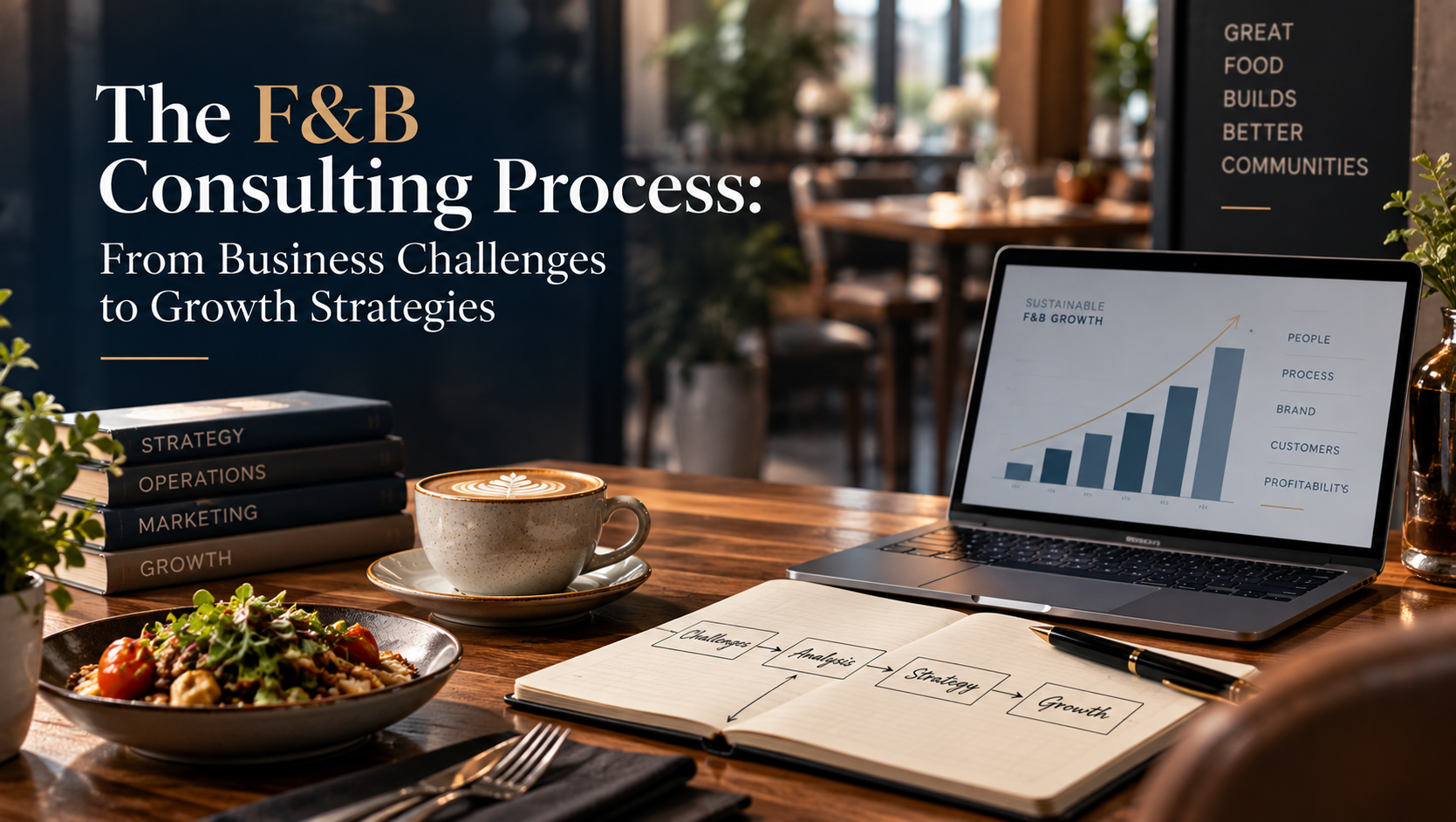
The Food and Beverage Consulting Process: From Business Challenges to Growth Strategies
Most food and beverage owners who call in outside help can describe a symptom clearly. Footfall is flat, margins are thinner than they should be, a second outlet is not performing like the first. But the actual cause is rarely as obvious as the symptom. A consulting process that's worth paying for starts by resisting the urge to jump straight to solutions and spends real time understanding what's actually driving the number that looks wrong.
Where Food and Beverage Engagements Usually Start
The opening conversation is almost never "we need a marketing campaign," even when that's how the request first comes in. It's closer to "we're busy but not profitable," or "the food hasn't changed but sales have dropped," or "we don't know if the problem is the menu, the location, or the team." Naming the real starting point matters, because a marketing fix applied to an operations problem, or the other way around, burns budget without moving the number that actually needed to move.
The Diagnostic Phase
- Demand mapping: where customers are actually coming from today, and which of those sources are growing, flat, or quietly shrinking.
- Capacity and throughput: whether the kitchen, seating, or delivery packing process can actually handle more volume before spending a rupee to generate more of it.
- Cost structure: food cost, labour cost, and rent as a share of revenue, checked against what a healthy business in the same format should look like.
- Brand and experience: whether what the business says about itself matches what a customer actually experiences walking in or ordering online.
This diagnostic-first approach is the whole point of [how the AyC Tribe works inside a business](https://aaythamconsulting.com/difference): sitting in the operation and mapping demand, capacity, and cost on the wall before deciding what's actually worth building.
From Diagnosis to Strategy
Once the real bottleneck is clear, the strategy phase is about prioritization, not a long wish list. A business losing money on food cost doesn't need a new loyalty program before it fixes portioning and supplier pricing. A business with strong margins but flat footfall doesn't need an operations overhaul before it fixes demand generation. Good strategy work names the one or two levers that will move the number that matters most, in the order that actually makes sense for that specific business.
Benchmarking the plan against comparable food and beverage brands, using something like [a structured competitive analysis](https://aaythamconsulting.com/blogs/how-to-conduct-a-competitive-analysis), helps confirm whether a gap is genuinely fixable or simply a constraint the whole category deals with.
What that prioritization looks like in practice: one AyC engagement started with a crowded category and a limited budget — a demand problem, not a product one. Rather than spreading spend thin, the plan was narrowed to a single connected system across Shopify, creatives, and Meta Ads, moving a customer from awareness to purchase in one deliberate path instead of scattered campaigns. That focus is what took the account to [5M+ reach, 500+ purchases, and 500% revenue growth](https://www.instagram.com/reel/DbVRH76iP3a/) — the same lever, applied consistently, instead of a wish list of tactics run in parallel.
Staying Through Execution
The difference between a consulting engagement that changes a business and one that produces a deck nobody opens again is what happens after the plan is agreed. Strategy, brand, and operations decisions need to be implemented inside the actual business: new SOPs trained with the team, a marketing plan run and measured, pricing changes rolled out and watched, not handed over as recommendations for someone else to execute eventually.
This is the foundation layer we call [building the right business](https://aaythamconsulting.com/craft): strategy, GTM, and revenue models that are only useful once they're actually running inside daily operations.
They Almost Said No to Aaytham Consulting
Six months later, they had a very different story to tell.
What changed? In this testimonial, Mr. Harris, Co-Founder of Fruit Shop on Greams Road, shares how the right perspectives, sharper business insights, and practical management consulting helped identify opportunities, strengthen their business, and create meaningful impact.
Sometimes, the biggest transformation begins with a second look. [Watch the story behind the decision that changed everything](https://www.instagram.com/reel/DavcqwBC4HS/?utm_source=ig_web_copy_link\&stkn=NTc4MTIwNjQ2YQ==).
If your food and beverage business is somewhere between "we know something's off" and "we don't know what to fix first," that second look is usually where the real process starts. [Start a conversation with the AyC Tribe](https://aaythamconsulting.com/contact?intent=client), or see [more growth stories from businesses we've worked with](https://www.instagram.com/p/Dc5JU9aGi15/).
---