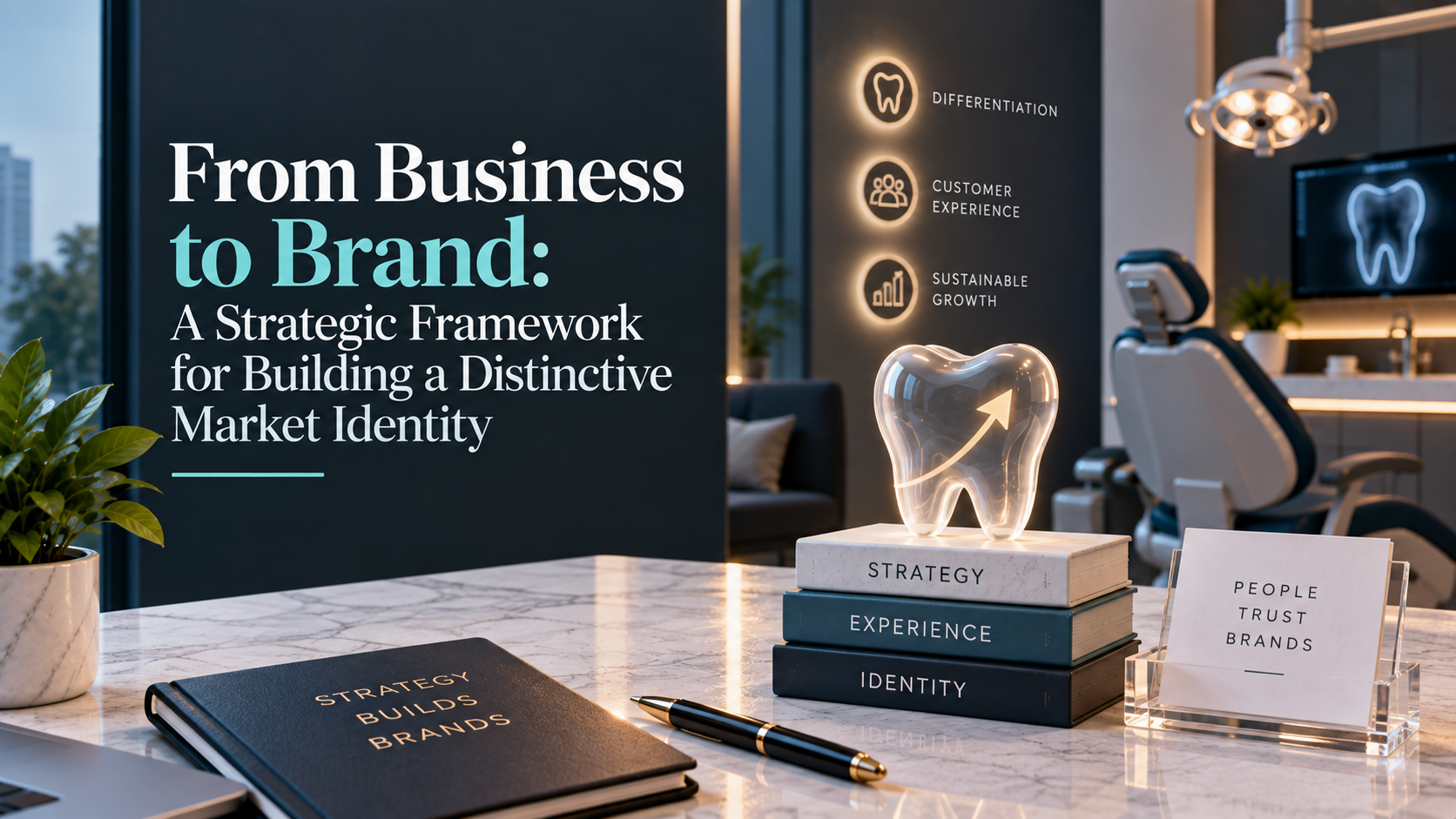
From Business to Brand: A Strategic Framework for Building a Distinctive Market Identity
Most businesses start as a functional offer: a product or service that solves a real problem for a real customer. Somewhere along the way, some of these businesses become brands, with an identity customers recognize, prefer, and are willing to pay a little more for, while most stay exactly what they started as. The difference is rarely luck. It is usually a deliberate strategic framework applied consistently over time.
Why Some Businesses Never Become Brands
A business without a distinctive identity survives purely on functional performance: price, convenience, availability. That can work for a while, but it leaves the business permanently vulnerable to the next competitor who can match the function at a lower price or greater convenience. A brand, by contrast, gives customers a reason to stay even when a cheaper or more convenient alternative appears, because the relationship is no longer purely transactional.
As Aaytham Consulting put it recently, your business doesn't need more, it needs what's missing: more leads will not fix a weak conversion process, more customers will not help if they do not return, and more growth will not matter without the right systems behind it. Finding that specific gap, rather than adding more of what already exists, is usually the real starting point for turning a business into a brand.
A Four-Part Framework for Building Brand Identity
Foundation: a clear, honest answer to what the business actually stands for, beyond the product it sells, grounded in a vision the leadership genuinely believes and can sustain.
Position: a specific, defensible place in the customer's mind relative to real alternatives, built on genuine differentiation rather than generic claims every competitor could also make.
Experience: the actual, lived reality of interacting with the business, which has to prove the position rather than merely describe it, since customers trust what they experience far more than what they are told.
Consistency: the discipline of protecting the foundation, position, and experience as the business adds people, locations, and channels, so growth does not quietly dilute what made the brand distinctive in the first place.
Applying the Framework Without Overcomplicating It
None of these four parts require an elaborate rebrand to get started. Most businesses can make real progress simply by writing down, honestly, what they believe their foundation and position actually are today, then walking through their own customer journey as if they were a first-time customer to see where experience contradicts that intended position. This kind of honest internal audit, done before any redesign work begins, usually surfaces more valuable insight than a new logo ever could.
Finding the Gap Is the Real Strategic Work
The hardest part of this framework is rarely execution, most businesses are capable of implementing a clear plan once they have one. The hard part is diagnosis: knowing which of the four parts, foundation, position, experience, or consistency, is actually the weak link holding the business back from becoming a genuine brand. Guessing wrong here means spending real effort and budget on the wrong problem while the actual gap stays unaddressed.
This diagnostic work is exactly where Aaytham Consulting starts every engagement, combining strategic planning and operations, brand positioning and marketing, and broader business consulting to find the specific gap before recommending a fix. See our journey and impact pages for how this plays out with real clients, or get in touch to find the gap in your own business before spending another rupee trying to grow around it.