
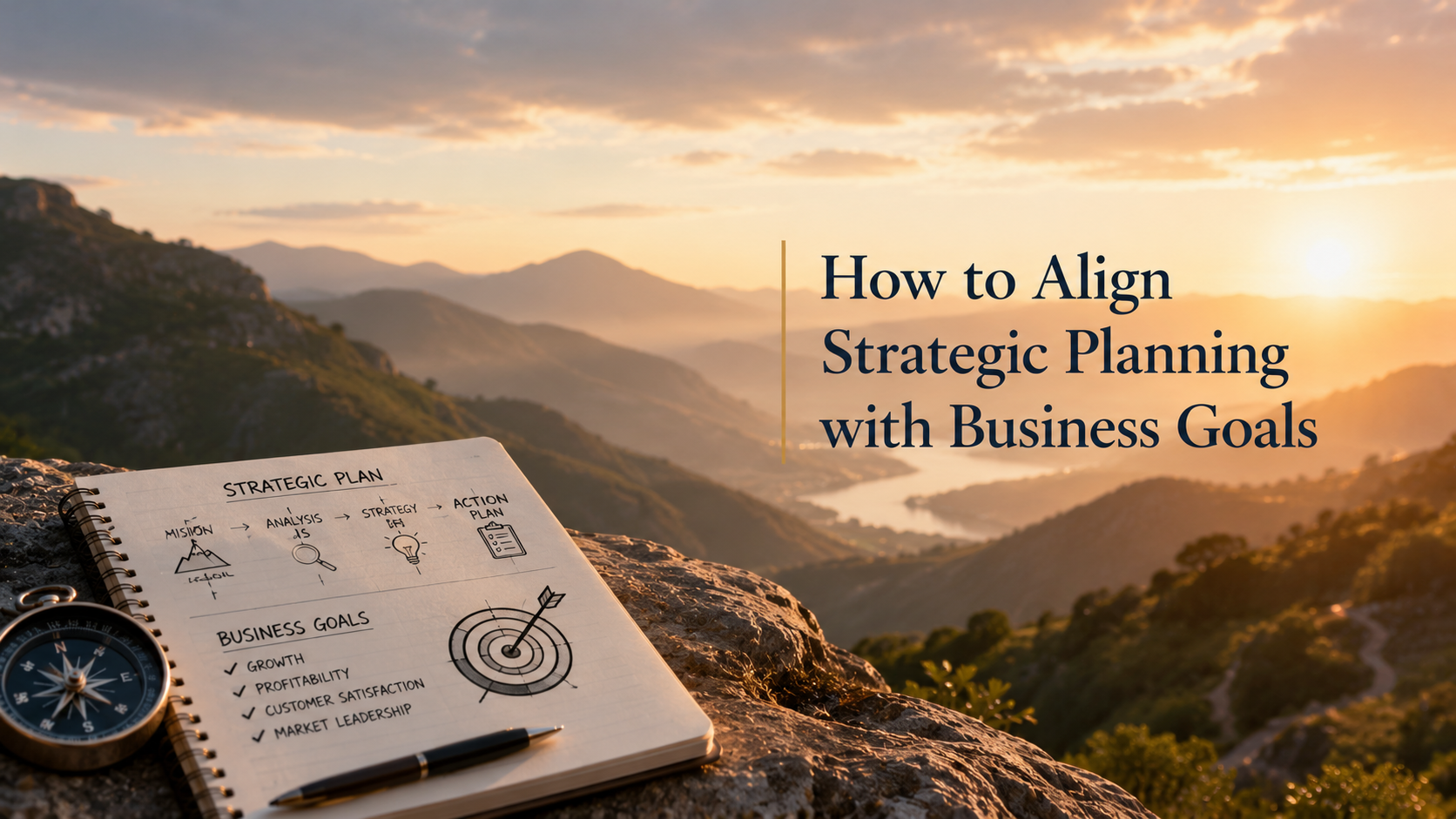
How to Align Strategic Planning with Business Goals
Strategic planning only creates value when it is tightly aligned with actual business goals. Too often, organizations produce a strategic plan that looks impressive on paper but has little connection to what the business is actually trying to achieve.
This disconnect is one of the most common reasons strategic planning initiatives fail to deliver measurable results. In this guide, we break down how to align strategic planning with business goals in a way that is practical, actionable, and built to survive contact with day-to-day operations — the same approach the tribe at [Aaytham Consulting](https://aaythamconsulting.com/) uses when working inside client businesses.
Why Strategic Alignment Matters
A strategic plan that isn't aligned with business goals becomes a document that sits in a drawer.
When strategic planning is properly aligned with business goals, every initiative, budget decision, and hiring plan can be traced back to a measurable outcome. This is why [Aaytham Consulting's approach to building the right business](https://aaythamconsulting.com/craft) starts with diagnosis, not decks — strategy, GTM planning, and revenue models are only useful when they map directly to what leadership is trying to accomplish.
Step 1: Define Clear, Measurable Business Goals
Before any strategic plan can be built, business goals need to be defined in concrete, measurable terms.
Vague goals like "grow the business" or "improve customer experience" don't give a strategic plan anything to align to. Effective business goals specify a metric, a target, and a timeframe — for example, increasing revenue per location by a defined percentage within twelve months.
Once goals are this specific, strategic planning becomes a matter of engineering, not guesswork.
Step 2: Translate Business Goals into Strategic Priorities
The next step in strategic planning is translating each business goal into a small number of strategic priorities.
If a business goal is to expand into new markets, the strategic priority might be building a repeatable market-entry playbook. [Aaytham Consulting's field notes on go-to-market strategy](https://aaythamconsulting.com/blogs/how-to-develop-a-gtm-strategy-plan) offer a useful framework for turning a growth goal into a structured plan covering market research, channels, pricing, and KPIs.
Step 3: Build a Strategic Plan That Maps Directly to Objectives
A strategic plan should read like a bridge between today's business goals and tomorrow's results.
Each initiative in the plan should have:
- A clear owner
- A defined resourcing plan
- A measurable outcome
- A direct connection to the underlying business goal
This is the operating philosophy behind [how the AyC Tribe works inside a business](https://aaythamconsulting.com/journey) — thinking through problems on the ground rather than presenting strategic plans from the outside.
Step 4: Assign Ownership and Build Accountability
Strategic planning fails most often not because the plan was wrong, but because no one owned the execution.
Every strategic objective needs a named owner who is accountable for outcomes, not just activity. [Aaytham Consulting's principle of ownership over assigned tasks](https://aaythamconsulting.com/difference) is central to why strategic plans built with the tribe tend to actually get executed rather than stall in committee.
Step 5: Track Progress Against Business Goals, Not Just Activity
Strategic planning needs a feedback loop.
Instead of tracking how many meetings were held or how many campaigns were launched, track the underlying business goal metrics directly:
- Revenue per unit
- Customer retention rate
- Market share
- Customer acquisition cost
- Profitability
- Growth rate
If a strategic initiative isn't moving the goal, it needs to be corrected or cut, not defended.
A strong customer retention strategy is often part of this loop — see [the impact of customer retention on business growth](https://aaythamconsulting.com/blogs/the-impact-of-customer-retention-on-business-growth) for how retention metrics tie back into overall business goals.
Common Mistakes When Aligning Strategy with Business Goals
The most common mistakes include:
- Setting goals that are too broad to act on
- Building strategic plans in isolation from the teams who will execute them
- Focusing on activities instead of measurable outcomes
- Failing to assign clear ownership
- Not revisiting the plan when market conditions shift
Strategic planning is not a once-a-year exercise. It is a living system that should be revisited as often as the business goals themselves change.
Businesses that treat strategy as a static document, rather than an operating system, are the ones [most firms stop at, where the real work begins](https://aaythamconsulting.com/) — exactly the gap real strategic execution is meant to close.
How Aaytham Consulting Aligns Strategy with Business Goals
Aaytham Consulting treats strategic planning as inseparable from execution.
Rather than handing over a strategic plan and walking away, the tribe stays embedded until the plan is actually driving the business goals it was built for.
You can see this reflected in [real client outcomes and revenue lift data](https://aaythamconsulting.com/impact), and in [the six builds that make up the AyC craft](https://aaythamconsulting.com/craft), starting with building the right business strategy before anything else is layered on top.
Conclusion
Aligning strategic planning with business goals is what separates a strategy that gets talked about from a strategy that gets executed.
It requires:
- Clear and measurable goals
- A strategic plan that maps directly to those goals
- Real ownership and accountability
- Disciplined tracking and feedback
- The flexibility to adapt as business conditions change
If your organization's strategic plan feels disconnected from its business goals, it may be time to bring in a partner who works inside the business rather than around it.
[Start a conversation with the AyC Tribe](https://aaythamconsulting.com/contact?intent=client) or [browse more field notes on strategy and growth](https://aaythamconsulting.com/blogs) to see how strategic alignment is done in practice.
Related Reading and Resources
For a deeper look at how strategy translates into execution, explore:
- [Aaytham Consulting's home page](https://aaythamconsulting.com/) for an overview of how the tribe operates
- [The AyC journey](https://aaythamconsulting.com/journey) for a walk-through of the process
- [What makes the tribe different](https://aaythamconsulting.com/difference)
- [The six builds that make up the craft](https://aaythamconsulting.com/craft)
- [Documented client impact](https://aaythamconsulting.com/impact)
- [The people behind the work](https://aaythamconsulting.com/tribe)
You can also [apply to join the tribe](https://aaythamconsulting.com/contact?intent=join) if you're a builder looking for your next challenge.