
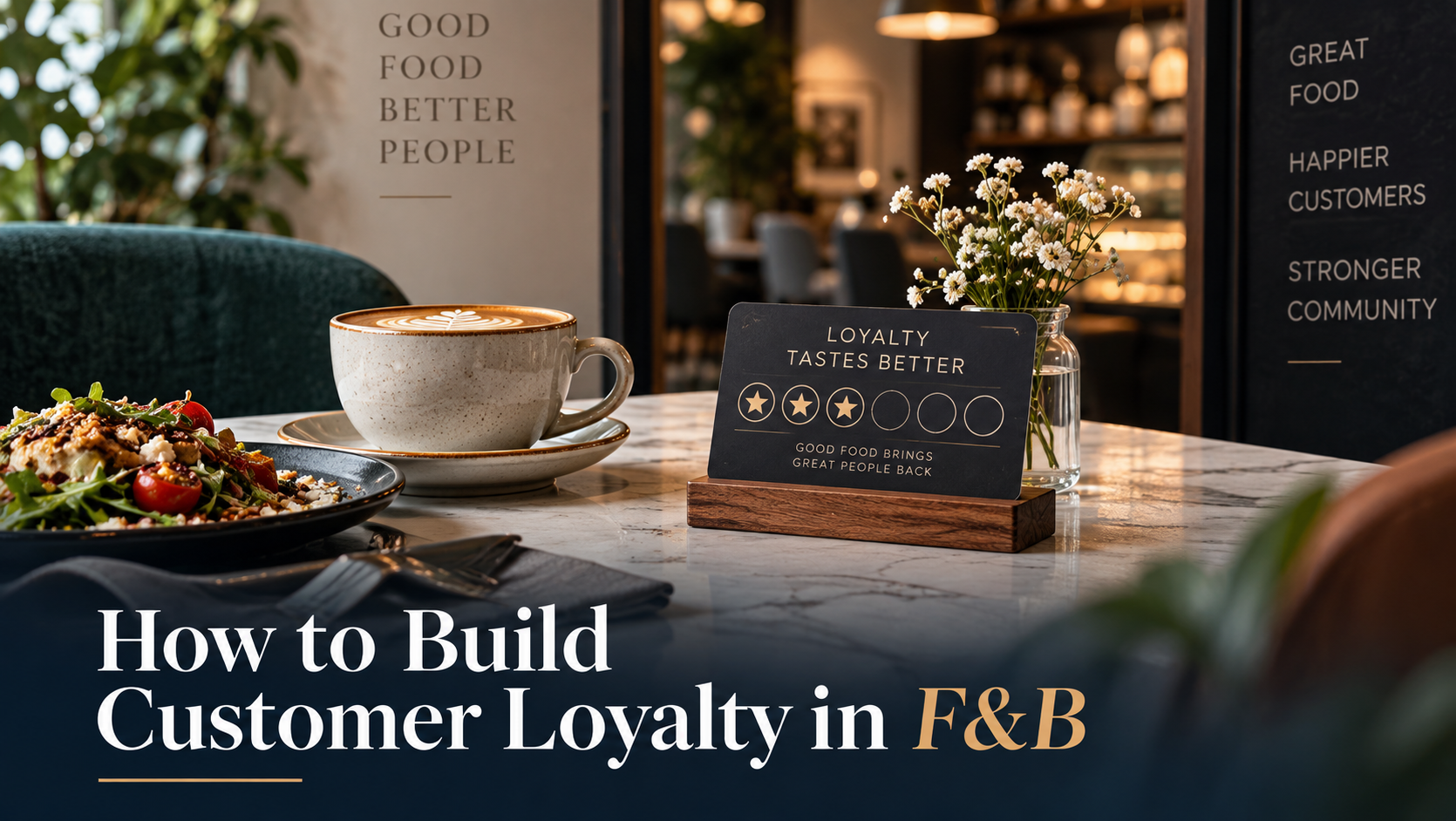
How to Build Customer Loyalty in Food and Beverage
Loyalty in food and beverage behaves differently than in most categories. The purchase frequency is high, the switching cost is close to zero, since there's always another cafe or restaurant a short walk away, and the patience for a bad experience is thin, because eating out is discretionary and emotional in a way a lot of other purchases are not. That combination means loyalty in food and beverage has to be earned actively; it rarely happens by default just because the food is good.
Why Food and Beverage Loyalty Is Harder Than It Looks
A customer can love a dish and still never come back, simply because nothing reminded them to, or because a competitor happened to be more convenient that week. Good food is the entry ticket, not the loyalty driver. It gets someone to finish the meal, not to choose you again next Friday. The brands that build real loyalty treat it as a system to design, not a byproduct of quality they can take for granted.
What Actually Builds Loyalty
- Consistency, every single visit: the fastest way to lose a loyal customer is a great first visit followed by an inconsistent second one. Portion size, service speed, or taste that varies by shift undoes acquisition spend that already worked. This is the same principle behind [why brand consistency drives sales](https://aaythamconsulting.com/blogs/the-importance-of-brand-consistency-in-generating-sales) a customer's trust in a brand is built visit over visit, not campaign over campaign.
- Recognition, not just rewards: a regular who is remembered by name, or whose usual order is recalled without asking, builds an emotional connection that a generic discount code never will.
- Value beyond the discount: early access to a new menu item, a birthday surprise, or being asked for feedback and seeing it acted on tends to build more loyalty than blanket percentage-off promotions that train customers to wait for the next deal. This is where [customer feedback earns its place in a retention strategy](https://aaythamconsulting.com/blogs/the-importance-of-customer-feedback-in-retention) rather than sitting unread in a review inbox.
- A reason to return that is not random: a predictable trigger, such as a weekly special, a subscription, or a punch card that's actually worth completing, gives a customer a reason to plan their next visit instead of leaving it to chance.
This is the layer that sits just past [acquisition — getting someone in the door for the first time](https://aaythamconsulting.com/blogs/what-is-customer-acquisition-and-why-is-it-important) and it's usually where food and beverage brands underinvest relative to how much they spend getting new customers in the first place.
Loyalty Programs Done Right vs Wrong
A loyalty program done wrong is a points system nobody remembers to check, sending the same 10 percent off code to every customer regardless of how often they visit. Done right, it's simple enough to explain in one sentence, rewards behaviour that actually matters to the business, such as frequency and higher basket size, and uses the data it collects to personalize the next offer rather than blasting the same message to everyone on the list.
What This Looks Like With a Real Client
Fruit Shop on Greams Road is one of the clearer examples of what loyalty built as a system looks like in practice. AyC's engagement with Fruit Shop wasn't a one-off campaign; it's an ongoing partnership, and [CEO Haris Abdulla](https://www.instagram.com/reels/DavcqwBC4HS/) has spoken directly about the trust behind it a brand more than three decades old, scaling across outlets, that still needed a deliberate system behind the loyalty it had earned informally for years. That's the shift from loyalty as a personality trait of a well-loved shop to loyalty as infrastructure that survives growth.
Measuring Loyalty Properly
Repeat visit rate over a rolling 90 days, average frequency per loyal customer, and the share of monthly revenue coming from repeat versus first-time customers are the numbers that actually describe loyalty, not follower counts or how many people redeemed a single offer. A brand with strong loyalty numbers can often sustain slower growth in new customers far more comfortably than a brand pulling in new faces every month with nothing bringing them back.
This is part of what we mean by [building growth engines that compound](https://aaythamconsulting.com/craft) rather than just generate reach. Loyalty is the multiplier that makes every acquisition rupee spent worth more over time.
Scaling Loyalty Across Outlets
Loyalty mechanics that work at a single outlet, such as the manager who remembers regulars or the informal punch card kept behind the counter, rarely survive a second or third location unless they're deliberately systemized: a shared CRM, a documented recognition standard, and a program structure that doesn't depend on one person's memory. Brands that get this right treat loyalty as infrastructure to be built once and rolled out consistently, not a personality trait of a single outlet's staff.
Practices and brands that put this kind of system in place are the ones showing up in the indexed growth AyC tracks across engagements, with loyalty compounding quietly in the background while acquisition gets the attention. If you're scaling a food and beverage brand and want a clearer read on what's actually driving your repeat visits, [start a conversation with the AyC Tribe](https://aaythamconsulting.com/contact?intent=client).
---