
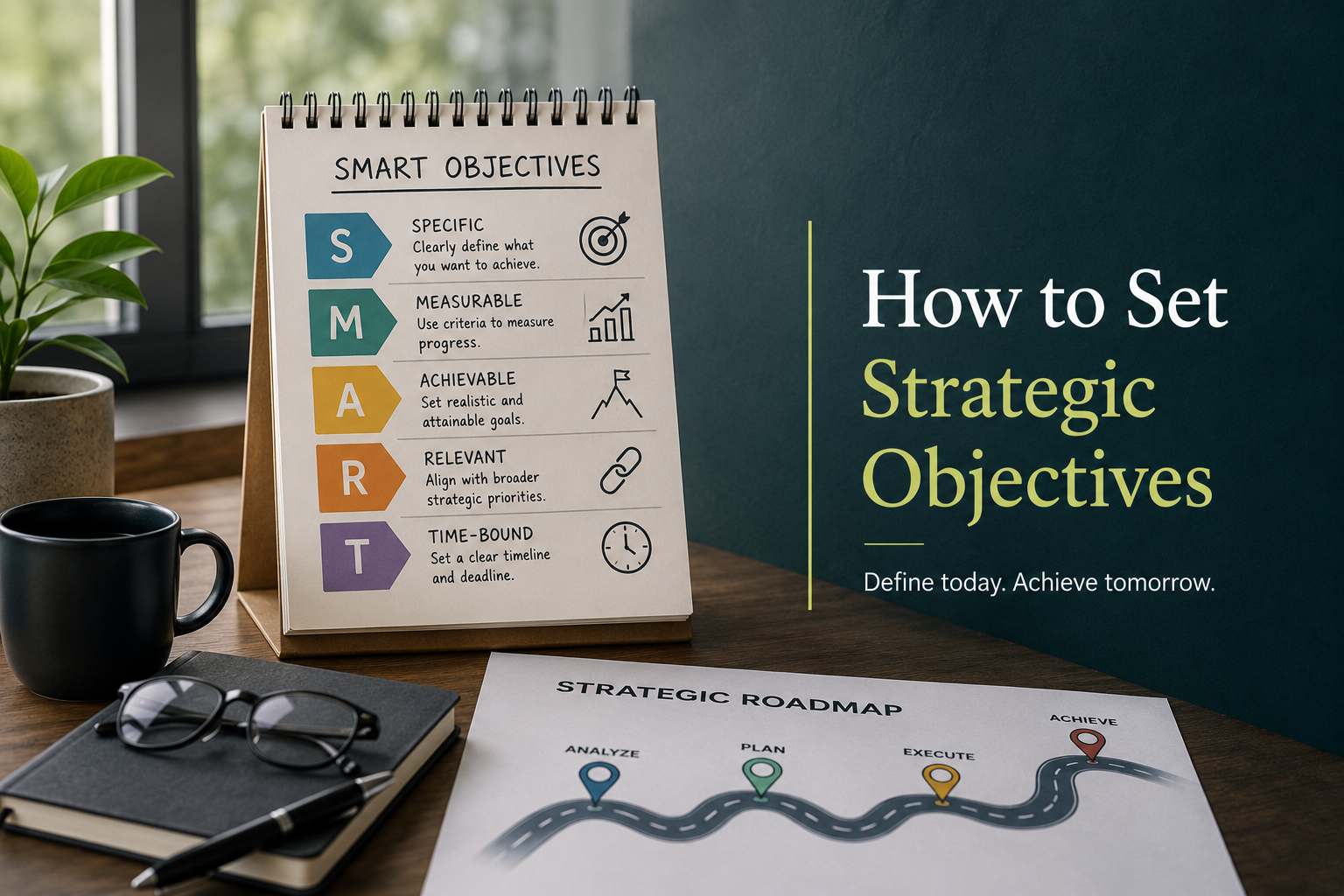
How to Set Strategic Objectives
Setting strategic objectives is where strategic planning either becomes real or stays theoretical. Objectives are the bridge between a broad business goal and the specific initiatives a team executes day to day.
Many organizations struggle here — not because they lack ambition, but because their strategic objectives are too vague to act on. This guide lays out a practical framework for setting strategic objectives, drawing on the same disciplined approach [Aaytham Consulting](https://aaythamconsulting.com/) uses when building growth roadmaps for clients.
What Makes a Strategic Objective Different from a Goal
A business goal describes the desired outcome — grow revenue, expand market share, or improve retention.
A strategic objective is the specific, measurable milestone that moves the business toward that goal within a defined timeframe.
Strategic planning breaks down when goals are mistaken for objectives, because goals alone don't tell a team what to do on a Monday morning.
Step 1: Anchor Strategic Objectives to Business Goals
Every strategic objective should trace back to a specific business goal.
If the goal is customer growth, a strategic objective might be increasing qualified leads from a specific channel by a set percentage.
[Key strategies for effective customer acquisition](https://aaythamconsulting.com/blogs/key-strategies-for-effective-customer-acquisition) offers a useful reference for translating a growth goal into acquisition-specific objectives.
Step 2: Make Strategic Objectives Specific and Measurable
Strategic objectives need a number and a deadline to be useful.
"Improve customer experience" is a goal; "reduce average response time to under two hours within one quarter" is a strategic objective.
A useful way to structure objectives is through the SMART framework:
- Specific — Clearly define what needs to be achieved.
- Measurable — Attach a metric or KPI to track progress.
- Achievable — Ensure the objective is realistic given available resources.
- Relevant — Connect the objective directly to a broader business goal.
- Time-bound — Set a clear deadline for achievement.
[The importance of customer service in retention](https://aaythamconsulting.com/blogs/the-importance-of-customer-service-in-retention) shows how measurable service objectives translate directly into retention outcomes.
Step 3: Prioritize a Small Number of Strategic Objectives
A common mistake in strategic planning is setting too many objectives at once, spreading resources thin and diluting focus.
Most well-run strategic plans concentrate on three to five objectives per cycle.
This is consistent with [how the AyC Tribe approaches the craft](https://aaythamconsulting.com/craft) — six builds, but only the ones the business genuinely needs at that stage, not everything at once.
Step 4: Connect Strategic Objectives to Channels and Content
Objectives around growth or awareness usually need to be broken down further into channel-level and content-level targets.
For example, a broad objective around customer acquisition might translate into specific targets for:
- Qualified leads from social media
- Website conversions
- Content engagement
- Search-generated demand
- Campaign-level acquisition costs
[How to use social media for customer acquisition](https://aaythamconsulting.com/blogs/how-to-use-social-media-for-customer-acquisition) and [how to use social media for content distribution](https://aaythamconsulting.com/blogs/how-to-use-social-media-for-content-distribution) are useful for setting objectives at the execution layer, where strategic planning meets day-to-day marketing work.
Step 5: Set Retention and Loyalty Objectives, Not Just Acquisition Objectives
Strategic objectives focused only on new customer acquisition miss half the growth equation.
Retention-focused objectives can include:
- Reducing customer churn
- Increasing repeat purchase rate
- Improving customer retention
- Increasing loyalty program participation
- Improving customer lifetime value
[The impact of customer retention on business growth](https://aaythamconsulting.com/blogs/the-impact-of-customer-retention-on-business-growth) and [the impact of brand identity on customer loyalty](https://aaythamconsulting.com/blogs/the-impact-of-brand-identity-on-customer-loyalty) both make the case for balancing acquisition and retention objectives.
Step 6: Assign Ownership and Review Cadence
Every strategic objective needs a named owner and a regular review cadence — monthly or quarterly, depending on the pace of the business.
Objectives without an owner tend to quietly disappear from strategic planning conversations.
[Aaytham Consulting's principle of ownership over assigned tasks](https://aaythamconsulting.com/difference) is exactly why objectives set with the tribe tend to get tracked rather than forgotten.
Step 7: Revisit and Adjust Strategic Objectives Regularly
Strategic objectives should be treated as hypotheses to be tested, not commitments carved in stone.
If an objective isn't moving the underlying business goal, it should be revised. This iterative approach is visible in [Aaytham Consulting's documented client impact](https://aaythamconsulting.com/impact), where objectives are adjusted based on what the data shows, not what the original plan assumed.
Conclusion
Setting strategic objectives well is what turns strategic planning from an annual ritual into a working system.
Objectives need to be:
- Specific
- Measurable
- Limited in number
- Connected to business goals
- Owned by someone
- Reviewed regularly
- Flexible enough to evolve with new information
If your business needs help turning broad goals into strategic objectives that actually get executed, [talk to the AyC Tribe](https://aaythamconsulting.com/contact?intent=client) or explore [more field notes on strategy and growth](https://aaythamconsulting.com/blogs). You can also [learn more about the tribe behind the work](https://aaythamconsulting.com/tribe).
Related Reading and Resources
For more on how objectives connect to execution, explore:
- [Aaytham Consulting's home page](https://aaythamconsulting.com/)
- [The AyC journey](https://aaythamconsulting.com/journey)
- [What makes the tribe different](https://aaythamconsulting.com/difference)
- [Documented client impact](https://aaythamconsulting.com/impact)
- [Get in touch](https://aaythamconsulting.com/contact) to discuss your own strategic objectives
You can also [apply to join the tribe](https://aaythamconsulting.com/contact?intent=join).