
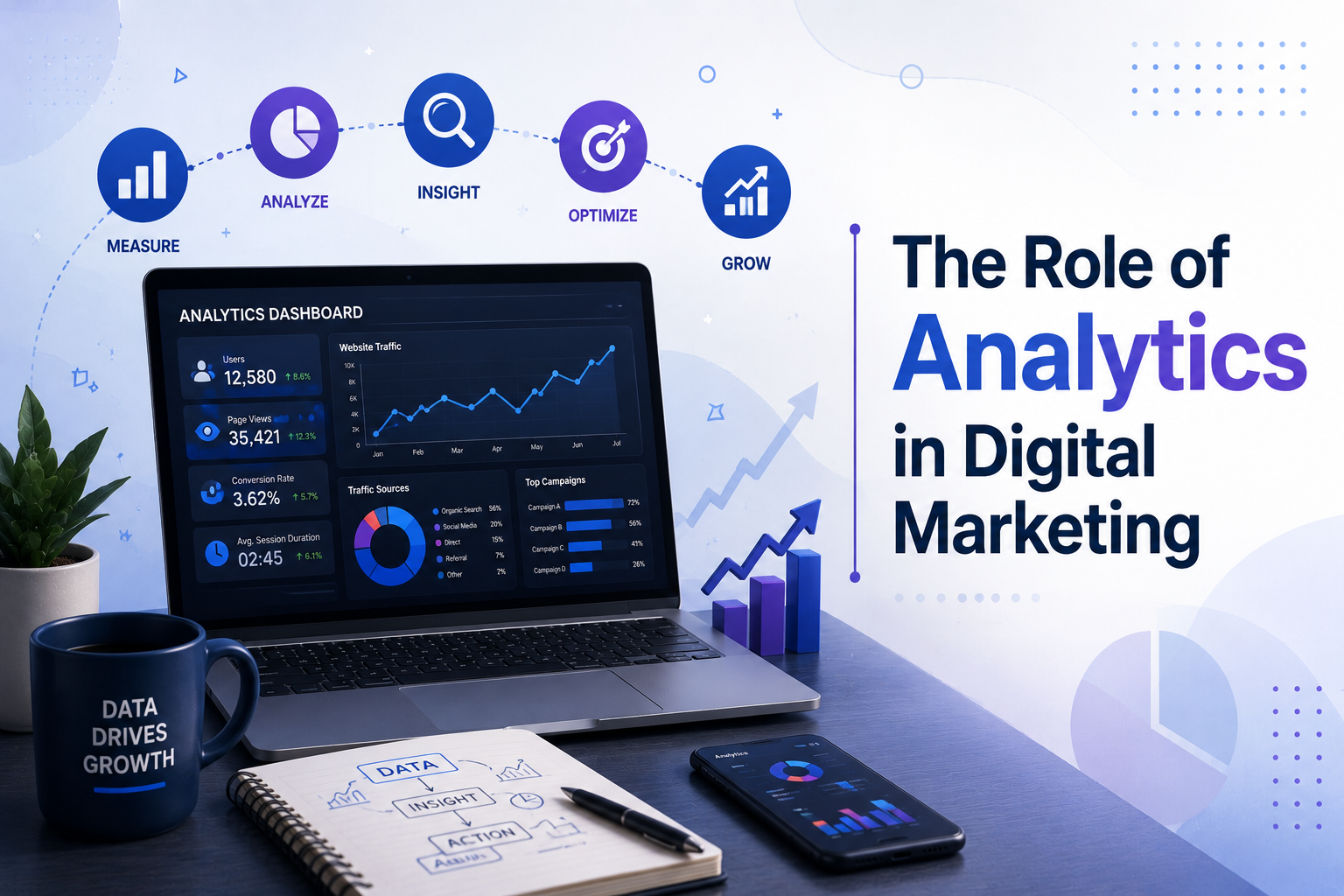
The Role of Analytics in Digital Marketing
Digital marketing has transformed the way businesses connect with their audiences. But simply running advertisements, publishing content, or sending emails is no longer enough.
With competition increasing across digital channels, businesses need more than assumptions to understand what works. They need data.
This is where digital marketing analytics comes in.
Analytics is not just about counting views, clicks, or impressions. It is about turning data into meaningful insights that help businesses make smarter decisions, improve campaigns, understand customers, and achieve better marketing outcomes.
What Is Digital Marketing?
Before understanding the role of analytics, it is important to understand what digital marketing involves.
Digital marketing is the process of promoting products or services through digital channels. It can include:
- Social media marketing.
- Search engine optimisation (SEO).
- Search advertising.
- Email marketing.
- Content marketing.
- Video marketing.
- Display advertising.
- Website marketing.
One of the biggest advantages of digital marketing is measurability. Businesses can monitor how people interact with their campaigns, identify what is working, and make changes based on performance.
However, having access to data is not enough. Businesses need a clear digital marketing strategy to turn that data into action.
Why You Need a Digital Marketing Plan
A digital marketing plan provides direction for your marketing activities.
It defines:
- What you want to achieve.
- Who you want to reach.
- Which channels you will use.
- What content or campaigns you will create.
- How you will measure success.
Without a clear plan, businesses can end up spending money across multiple channels without knowing which activities are actually contributing to their goals.
Analytics helps answer important questions such as:
- Which campaigns are generating results?
- Which channels are bringing the most valuable customers?
- Where are potential customers dropping off?
- Which content is generating engagement?
- Where should the marketing budget be increased or reduced?
Instead of relying on guesswork, businesses can use these insights to make informed decisions.
How Analytics Helps Digital Marketing Campaigns Succeed
Every digital campaign should be evaluated based on measurable outcomes.
Whether it is a social media campaign, email campaign, paid advertisement, or content marketing initiative, analytics provides the information needed to understand performance.
1. Measuring Success and Failure
Analytics helps businesses understand exactly how campaigns are performing.
Depending on the campaign, important metrics may include:
- Click-through rate (CTR).
- Conversion rate.
- Bounce rate.
- Cost per acquisition.
- Customer acquisition cost.
- Engagement rate.
- Return on advertising spend (ROAS).
For example, an email campaign may achieve a high open rate but generate very few website visits or conversions.
This tells marketers that the subject line may be effective at generating attention, but the content or call-to-action may need improvement.
Instead of treating the campaign as simply successful or unsuccessful, analytics helps identify where the problem exists.
2. Understanding Your Audience
Analytics provides valuable insights into how customers interact with your digital presence.
Businesses can analyse:
- Which pages visitors spend the most time on.
- Which content receives the most engagement.
- Where visitors enter and leave a website.
- Which channels generate traffic.
- What actions users take before converting.
These insights can help businesses understand customer behaviour and improve their digital experiences.
Analytics can also support audience segmentation.
Instead of delivering the same message to everyone, businesses can create different audience groups based on factors such as interests, previous interactions, purchase behaviour, or engagement.
This makes marketing communication more relevant and targeted.
3. Making Real-Time Improvements
One of the biggest advantages of digital marketing is flexibility.
Unlike traditional advertising formats that can be difficult or expensive to change once published, many digital campaigns can be adjusted while they are running.
For example, if a social media advertisement is receiving impressions but generating very few clicks, marketers can test:
- A different headline.
- A new creative.
- A different call-to-action.
- A new audience segment.
- A different landing page.
Analytics provides the feedback required to make these decisions.
The goal is not simply to collect data but to use it to improve campaign performance while the campaign is still active.
Analytics and Email Marketing
Email marketing is another area where analytics can significantly improve performance.
Email platforms provide valuable information about how recipients interact with campaigns.
Common metrics include:
- Open rate.
- Click-through rate.
- Bounce rate.
- Unsubscribe rate.
- Conversion rate.
For example, if an email receives a strong open rate but a low click-through rate, marketers may need to evaluate the email content, offer, layout, or call-to-action.
A/B Testing
Analytics also makes it possible to test different versions of an email.
For example:
- Version A could use a short, curiosity-driven subject line.
- Version B could use a direct and informative subject line.
By comparing performance, marketers can identify which approach resonates better with their audience.
The insights from these tests can then be applied to future campaigns.
Using Analytics to Continuously Improve
Digital marketing is not a one-time activity.
It is a continuous cycle of planning, execution, measurement, learning, and optimisation.
Analytics supports this cycle by helping businesses identify opportunities and make better decisions over time.
Spotting Trends
Historical and current data can reveal changes in customer behaviour, interests, purchasing patterns, and channel performance.
Identifying these trends early can help businesses adapt their strategies before competitors.
A/B Testing
Testing different versions of advertisements, landing pages, emails, headlines, and other marketing elements allows businesses to make decisions based on actual user behaviour.
Predicting Future Performance
Historical data cannot predict the future with certainty, but it can provide useful indicators.
By analysing previous campaign performance and customer behaviour, businesses can identify patterns and make more informed decisions about future campaigns and budgets.
From Data to Action
Having access to analytics does not automatically improve marketing performance.
The real value comes from turning data into action.
For example:
Data: A landing page receives significant traffic but very few conversions.
Insight: Visitors are interested enough to arrive but may not be finding enough value or clarity to take the next step.
Action: Test the headline, offer, page structure, trust signals, and call-to-action.
Result: Measure the changes and continue optimising based on the findings.
This is how analytics becomes a strategic marketing tool rather than simply a reporting system.
Common Mistakes in Digital Marketing Analytics
While analytics can provide powerful insights, businesses can still make mistakes when interpreting their data.
Focusing Only on Vanity Metrics
High impressions, views, or follower counts do not necessarily mean a campaign is achieving business objectives.
Metrics should always be connected to meaningful goals.
Tracking Too Many Metrics
Collecting large amounts of data can create confusion.
Businesses should identify the key performance indicators that matter most to their specific objectives.
Looking at Data Without Context
A metric rarely tells the complete story on its own.
Campaign performance should be considered alongside factors such as audience, budget, seasonality, creative changes, and business goals.
Failing to Take Action
Analytics is only valuable when it influences decisions.
If businesses collect reports but never change their strategy based on the insights, they are missing the real benefit of analytics.
Conclusion
Digital marketing without analytics is like driving without a map. You may be moving, but you cannot be certain that you are moving in the right direction.
Analytics removes much of the guesswork from digital marketing by providing businesses with measurable insights into campaign performance, customer behaviour, and marketing effectiveness.
From understanding your audience and measuring campaign results to conducting A/B tests and making real-time improvements, analytics helps businesses make smarter decisions.
The goal is not simply to collect more data.
The goal is to ask better questions, uncover meaningful insights, and turn those insights into actions that improve marketing performance and support business growth.
When businesses combine a clear digital marketing strategy with effective analytics, every campaign becomes an opportunity to learn, optimise, and grow.